
What is pupillary distance (PD) and why do glasses need it?
Pupillary distance is the distance in millimeters between the centers of your two pupils, and lens labs use it to place each lens's optical center directly in front of each pupil. Moving that optical center sideways relative to the pupil is called decentration, and decentration is what a wrong PD produces. PD is a dispensing measurement taken when frames are fitted, not a result of the refraction, which is why it is frequently absent from a US prescription. It is written either as one number for both eyes (63) or as two, one per eye (32/31), and it is a different measurement from the numbers stamped inside the temple, which describe the frame.
How do you measure your pupillary distance at home with a ruler and a mirror?
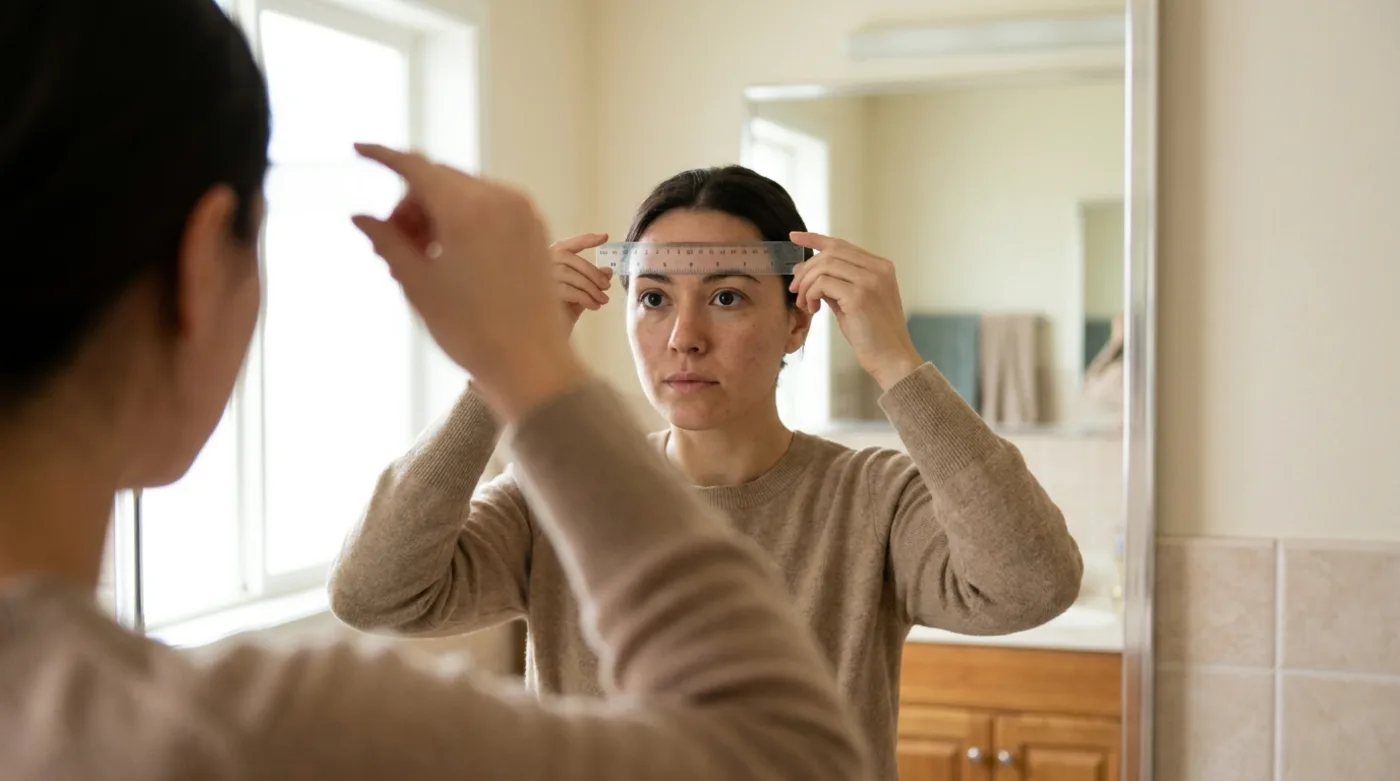
To measure pupillary distance with a mirror, stand about 20 cm from the mirror, hold a millimeter ruler flat against your brow, close your right eye and align the 0 mm mark with the center of your left pupil, then close your left eye and read the millimeter mark sitting over the center of your right pupil. The eye-closing alternation is the whole trick, because it removes the parallax that makes a two-eyes-open reading drift by millimeters.
- Use a real millimeter ruler. Check any printed PD ruler against a known object first — browser print scaling silently shrinks it.
- Stand roughly 20 cm from a mirror, ruler flat and level against your brow so it cannot rock forward.
- Focus both eyes on something far behind the mirror. Converging on your reflection gives you a near PD, several millimeters short.
- Close your right eye. Slide the 0 mm mark over the center of your left pupil, then hold the ruler still.
- Open your right eye, close your left. The mark over your right pupil center is your distance PD.
- Repeat three times. If the readings spread more than 2 mm, discard them and brace the ruler harder.
The ceiling is real: measuring yourself in a mirror is worth about ±1–2 mm and no better, because you are reading a millimeter scale through the same eye you are trying to locate. Having someone else hold the ruler at arm's length genuinely helps, provided their eyes are level with yours.
How do you measure PD from a phone selfie using a credit card for scale?
To measure pupillary distance from a selfie, hold a standard card flat under your nose with the long edge horizontal, take a straight-on photo at arm's length, then scale the pixel distance between your pupil centers against the card's known 85.60 mm width. Any payment card, driver's license or ID is the same size, because ISO/IEC 7810 ID-1 fixes it at 85.60 by 53.98 mm. That is what turns a photo into a measuring instrument, and it is the geometry Warby Parker's own PD tool runs on. Open the photo in any editor that shows cursor coordinates, read the pixel distance between the pupil centers and the pixel width of the card, then divide:
PD (mm) = (pupil-to-pupil pixels ÷ card-width pixels) × 85.60
Each failure mode biases the answer predictably. A tilted head foreshortens the pupil line, so PD reads low. A tilted card foreshortens the reference instead, inflating the millimeters-per-pixel scale so PD reads high. Shooting too close magnifies the card by perspective, since it sits roughly 40 mm nearer the lens than your pupils, dragging PD low again. Shoot from arm's length, and take your glasses off.
Which PD measurement method is most accurate?
A digital pupillometer used by an optician is the most accurate way to measure pupillary distance, and peer-reviewed testing puts the best smartphone PD apps at a mean absolute error of about 0.51 mm against it, while an unaided ruler-and-mirror reading is typically worth ±1–2 mm. In a 44-subject study published in Cureus, the Eye Measure and Warby Parker apps each produced a mean absolute error of 0.511 mm against a digital pupillometer, while PDCheck AR produced 1.375 mm. The method is not the variable there; the implementation is.
The more useful finding comes from a 40-participant comparison of pupillometer, PD ruler, autorefractor and app: the ruler read systematically larger and the apps systematically smaller, yet every method stayed inside the ISO 16034:2002 tolerance of less than 0.33 prism diopters. For ordinary prescriptions the at-home measurement is not the weak link. A skilled optician using a ruler also lands around ±1 mm, so "just ask an optician" buys less than people assume unless an instrument is involved.
| Method | Typical error | What you need | Best for | Main failure mode |
|---|---|---|---|---|
| Ruler + mirror, alone | ±1–2 mm (practical estimate) | mm ruler, mirror, good light | Prescriptions under about ±2.00 D | Parallax, and converging on your reflection instead of a distant point |
| Ruler + a friend | about ±1 mm (practical estimate) | mm ruler, a second person at arm's length | Most single-vision orders | Helper's eye height differing from yours reintroduces parallax |
| Selfie scaled to a card | ±1–2 mm (practical estimate) | Any ISO 7810 card, a photo editor | A cross-check on the ruler reading | Card tilt and shooting too close, which bias the scale in opposite directions |
| TrueDepth / AR PD app | 0.51 mm best, 1.375 mm worst (Cureus, n=44) | A recent iPhone | Most orders, including moderate prescriptions | App quality varies nearly 3× more than the method does |
| Optician + pupillometer | Reference standard (PubMed, n=40) | An appointment | Progressives, dual PD, anything over about ±5.00 D | None optically; it just requires a visit |
| Read off old glasses | Inherits the previous lab's error | Dry-erase marker, a helper | A sanity check only | Impossible on progressives, where the fitting cross is a manufacturing reference |
What is a normal pupillary distance?
A normal adult pupillary distance falls roughly between 54 mm and 74 mm, with men averaging a few millimeters wider than women, and children typically measuring 43–58 mm. The commonly quoted band is 53–65 mm for women and 55–70 mm for men; the wider 54–74 mm adult range and 43–58 mm children's range come from Zenni's dispensing guidance, which is what an online order actually accepts.
Those bands get copied around without a source. A measured cohort is better: an ophthalmic anthropometry study of rural adults in Mashonaland Central Province, Zimbabwe recorded a mean distance PD of 66.36 ± 5.32 mm in 206 males and 64.98 ± 4.27 mm in 265 females. A standard deviation near 5 mm means a PD that surprises you is almost certainly normal. Adult PD is stable, so remeasuring every two years is pointless absent facial surgery or trauma. And if your reading lands outside 50–78 mm, you measured wrong. Measure again.
What is the difference between distance PD and near PD?
Distance PD is measured with the eyes fixed on a far object, and near PD is 3–4 mm smaller because the eyes converge inward when focusing on something close. Convergence is a physical rotation of both eyes toward the nose, so the pupil centers genuinely move closer together at reading range. Near PD is not a different way of measuring the same thing, it is a different geometry. Distance PD is the number you want for every pair of glasses except dedicated readers and single-vision computer lenses.
Converting is arithmetic. For a single PD, subtract 3 mm: 63 becomes 60. For a dual PD, subtract 1.5 mm per eye: 33/31 becomes 31.5/29.5. For progressives, order the distance PD and nothing else. The lab derives the near zone from the corridor design itself, and hand-entering a near PD on a progressive order is one of the most common self-inflicted errors in online ordering.
Do you need a single PD or a dual (monocular) PD?
A single binocular PD is enough for ordinary single-vision lenses, but progressives, bifocals and strong prescriptions need a dual PD, one measurement from the center of the nose bridge to each pupil, because most faces are not perfectly symmetric. Asymmetry of 1–2 mm is common, so a 63 mm binocular PD can really be 33/30, and centring both progressive corridors at 31.5 mm then puts one of them 1.5 mm off. You cannot measure a dual PD reliably in a mirror, because the part self-measurement gets wrong is the nose-bridge midline reference. This is the one case where an optician or a TrueDepth app earns the trip.
How much does a 2 mm PD error actually matter?
A 2 mm pupillary distance error shifts each lens's optical center by 1 mm, which by Prentice's rule induces 0.8 prism diopters of total horizontal imbalance on a 4.00 D prescription, enough to fail the ANSI Z80.1 tolerance of 0.67 prism diopters, while the same 2 mm error on a 1.00 D prescription produces only 0.2 prism diopters and is imperceptible. Prentice's rule, as the American Academy of Ophthalmology states it, is that the prism power of a lens at any point equals the distance from the optical center in centimeters times the lens power in diopters: Δ = h (cm) × Power (D).
Run the numbers. A 2 mm PD error is 1 mm of decentration per eye, so h = 0.1 cm, and at 4.00 D each eye gets 0.1 × 4.00 = 0.4Δ, the two prisms opposing for 0.8Δ total. Generalizing: total induced prism ≈ PD error (mm) × power (D) ÷ 10. The ANSI Z80.1 tolerance for horizontal prism imbalance is ±0.67Δ from 0.00 D to ±2.75 D; above that it switches to ±2.5 mm on the distance between optical centers. Vertically it is ±0.33Δ up to ±3.37 D, then ±1.0 mm. Combining the two sources gives Frame's working figure: largest tolerable PD error ≈ 6.7 ÷ power in diopters.
- ±1.00 D tolerates about 6.7 mm of PD error
- ±2.00 D tolerates about 3.4 mm
- ±4.00 D tolerates about 1.7 mm
- ±6.00 D tolerates about 1.1 mm
- ±8.00 D tolerates about 0.8 mm
Under about ±2.00 D, a ruler-and-mirror measurement is fine. Over about ±5.00 D, or on any progressive, pay for a pupillometer. The American Academy of Ophthalmology makes the same point about symptoms: severity depends on the strength of the prescription and the degree of error, so a high-power progressive suffers from a small PD error while low-power single-vision glasses may cause no symptoms even when the PD is off significantly. Where symptoms appear: eye strain, headache after 20–30 minutes of wear, a pulling sensation, occasionally doubling.
Can you get your PD from your prescription or your old glasses?
Pupillary distance is often missing from a US eyeglass prescription because PD is a dispensing measurement taken when frames are fitted, not a result of the eye exam, but you can request it from the practice that dispensed your last pair or read it off your current glasses. Asking is the better route: the optician recorded a PD on the job order even if it never reached the printed prescription, and that is your record.
To measure the glasses you own, wear them, look at something distant, have a helper mark the point on each lens directly over your pupil with dry-erase marker, then measure between the dots. Two warnings. It reproduces whatever PD the previous lab used, error included, so it validates nothing. And it fails on progressives, where the fitting cross is a manufacturing reference, not a pupil position. PD is not in the lens engravings or the frame stamp either — 52□18-140 describes the frame, not your face.
Does PD matter for sunglasses and virtual try-on?
Pupillary distance does not affect non-prescription sunglasses, because a plano lens has no optical center to decenter, but it still matters for how the frame sits: a frame whose lens centers are far from your pupils looks off even with zero optical consequence. Keep the two questions apart. Optically, PD is irrelevant at plano and decisive above about ±2.00 D. Cosmetically it always matters, because frame width and bridge size decide where the lens centers land, so an unusually narrow or wide PD quietly rules out part of the catalog. That is a fitting problem, solved with the frame size notation and frame shape for your face — start by measuring your face shape, then read the shape-specific guide for round or square faces, and settle frame color against your skin tone last.
What Frame does and does not do: Frame's virtual try-on shows how a frame sits on your face. It does not measure your PD, and a try-on render is not a measurement. For the look, see how to try on glasses online for free and how accurate virtual try-on actually is. For the PD, use a ruler, a card or a pupillometer.
See the frame on your face first
Scan once, import any frame from any website, and know it suits you before you worry about millimeters.
Download Frame for iOS