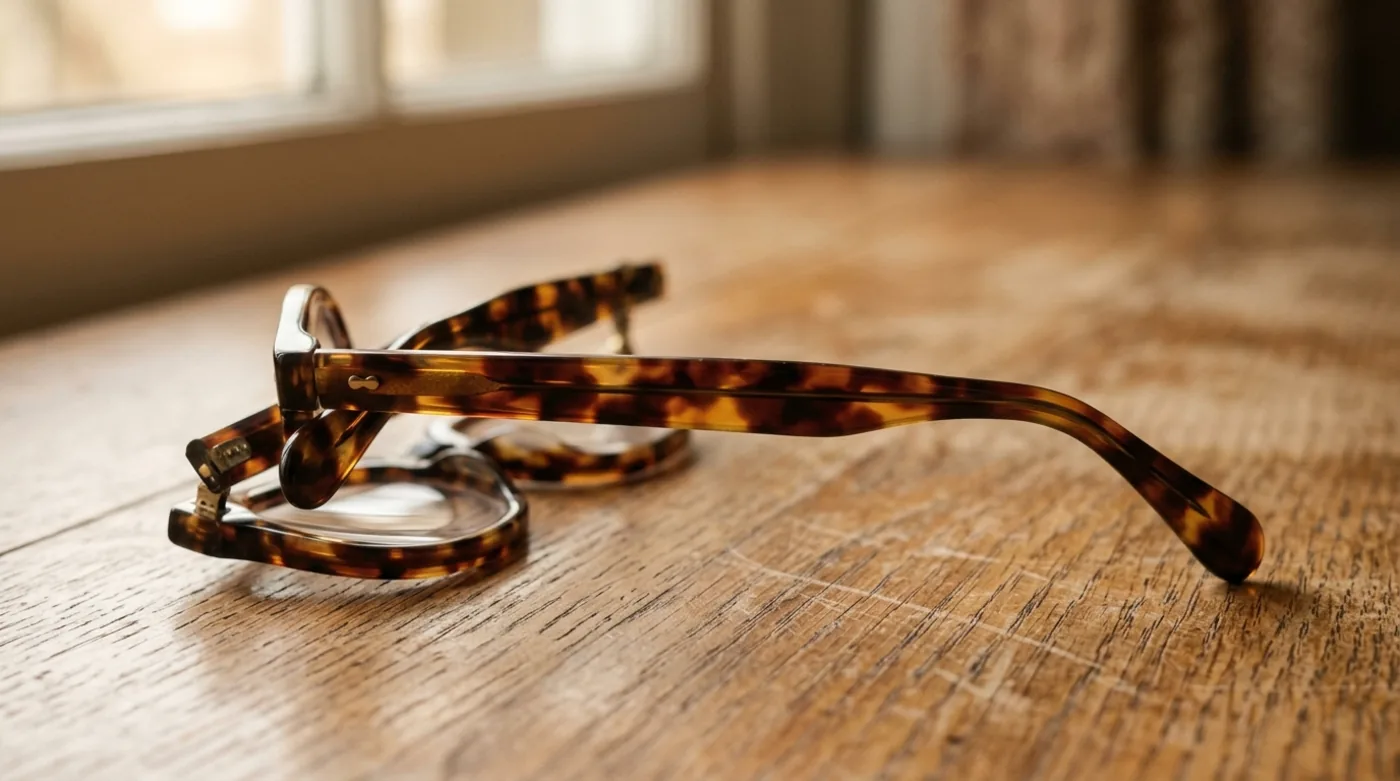
What do the three numbers on glasses mean?
All three numbers are millimeters. The □ is just a separator — some brands print 52-18-140.
- Lens width (52) — the horizontal width of one lens at its widest point. Typical range: 47–58 mm.
- Bridge width (18) — the gap between the two lenses, where the frame sits on your nose. Typical range: 16–22 mm.
- Temple length (140) — the arm from hinge to tip. Almost always 135, 140, 145, or 150 mm.
Some frames print a fourth number (lens height) and sunglasses sometimes add a base-curve value, but the three above are the universal standard — you'll find them on a $12 Zenni frame and a $400 Lindberg alike.

What size are you?
If you own glasses that fit: read the numbers off the temple arm. Done — that's your baseline. When shopping, stay within ±2 mm on lens width and ±1 mm on bridge.
If you don't: measure your face width in a mirror — ruler held flat, temple to temple, just below eye level. No ruler? A credit card is exactly 85.6 mm wide, which is roughly the lens-plus-bridge span of a medium frame: hold it centered over one eye — if the card's far edge lands at the center of your nose and the near edge at your temple, you're a medium.
| Size | Face width | Lens | Bridge | Total frame width |
|---|---|---|---|---|
| Small | < 129 mm | 47–49 mm | 16–18 mm | 125–129 mm |
| Medium | 130–139 mm | 50–54 mm | 18–20 mm | 130–139 mm |
| Large | ≥ 140 mm | 55–58 mm | 20–22 mm | 140 mm + |
Compare total width, not lens width. A 52 mm lens in a thick acetate frame can be wider overall than a 54 mm rimless. Total width ≈ (lens × 2) + bridge + rim thickness — most retailers list it as "frame width". That's the number to match to your face.
Why does bridge width matter most?
Lens width has wiggle room; temple arms can be adjusted at any optician. The bridge cannot. It's rigid, it carries the frame's weight on your nose, and it's the reason a frame that's "your size" on paper slides down your face all day. Two millimeters too wide and the frame rests on cartilage instead of bone; two too narrow and it pinches.
If you have a lower nose bridge, also look for frames labeled low-bridge fit (larger nose pads, tighter bridge angle, slightly shorter lens height). Mainstream brands increasingly ship both fits of the same model — same style number, different bridge geometry.
Why don't the numbers tell you how glasses will look?
Frame measurements answer exactly one question: will it physically fit? They answer nothing about whether it suits you. Two frames stamped 52□18-140 — one round tortoise, one sharp black rectangle — sit identically and look nothing alike on the same face.
So use the numbers as a filter, then judge looks the reliable way:
- Filter by size — your baseline ±2 mm, bridge ±1 mm.
- Filter by shape — our face shape guide narrows the field to styles that flatter your geometry (there's a sunglasses version too).
- See the survivors on your face. A free virtual try-on renders any frame on a 3D scan of you — Frame anchors the render to your measured face proportions, so scale is real, not guessed.
Right size, right shape — verified on your face
Scan once. Import any frame. See true-to-scale renders in seconds.
Download Frame for iOS