

How do you find your face shape?
You find your face shape by taking four measurements — forehead width, cheekbone width, jaw width and face length — and comparing them against each other; whichever width is largest, and how face length relates to cheekbone width, names the shape. Six shapes come out of that comparison: oval, round, square, oblong, heart and diamond. With a soft tape measure and a mirror the whole procedure takes about three minutes, and once you have a shape the frame consequences are covered in our guide to choosing glasses by face shape.
The output is three things: the ratio of face length to cheekbone width, the rank order of the three widths, and whether the jaw turns a visible corner below the ear. Round and square faces have identical ratios and identical width rankings; only the jaw angle separates them.
What do you need to measure your face shape at home?
Measuring your face shape needs a soft fabric tape measure, a mirror, and hair pulled fully back off the forehead and ears — a rigid metal tape distorts the reading because it cannot follow the curve of the skull. A ruler works too, used to read straight-line distances against the mirror rather than wrapped.
What breaks the method is mixing the two. Surface distance around a curved cheek runs several millimeters longer than the straight-line chord between the same points, so a cheekbone measured with tape against a jaw measured with a ruler shifts the ratio by more than the tolerance the classification depends on. Pick one method for all four. Record in millimeters rather than fractional inches, look straight ahead with your head level, and do not smile — smiling widens the cheek reading.
How do you measure your forehead, cheekbones, jaw and face length?
Measure the four face-shape dimensions at fixed anatomical landmarks: forehead across the widest point between the temples, cheekbones from the bony point below the outer corner of one eye to the same point on the other side, jaw from the angle below one ear to the angle below the other, and face length from the center of the hairline straight down to the tip of the chin.
- Forehead width. Lay the tape horizontally across the widest span between your temples, roughly halfway between brow and hairline. This is the least standardized of the four, so pick a height and reuse it.
- Cheekbone width — bizygomatic breadth. Find the bony ridge just below and slightly outside the outer corner of each eye: the zygion. Measure straight across. This one also predicts frame size, so take it twice.
- Jaw width — bigonial breadth. Feel for the corner of the jawbone directly below each ear, where the vertical branch turns forward: the gonion. Measure straight across.
- Face length. Measure from the center of your hairline vertically down to the tip of the chin. The clinical equivalent runs from the nasion — the dip at the bridge of the nose — to the gnathion at the bottom of the chin, and gives a materially smaller number.
Two things go wrong here, and one of them is actively taught by the pages that rank for this query: most guides tell you to measure the jaw from below the ear to the center of the chin and double it. That is a chord approximation around a curve and it reads roughly 5–10 mm short of a true bigonial breadth. Measure across, not around.
The second problem is the hairline, and face length is the numerator of the only ratio that matters. If yours is receding or uneven, measure from the browline to the chin instead and note the different baseline — every threshold below assumes hairline-to-chin, so a browline reading lands you one band lower.
What ratios determine each face shape?
Face shape is determined by two things: which of the three widths (forehead, cheekbone, jaw) is largest, and the ratio of face length to cheekbone width — a ratio near 1.0 reads round or square, around 1.3 to 1.5 reads oval, and above roughly 1.5 reads oblong. Resolve them in that order.
- Compute length ÷ cheekbone width. This separates the long family (oval, oblong, heart, diamond) from the short family (round, square).
- Rank the three widths. Forehead widest means heart. Cheekbones clearly widest means diamond. All three within tolerance means square, round or oblong, decided by step 1.
- Look at the jaw angle. A visible corner below the ear is square; a smooth curve is round.
Treat two widths as equal when they are within about 5 mm of each other. That is roughly the repeatability of a home tape measurement on a curved surface, and treating a 3 mm difference as meaningful is how people talk themselves into the wrong shape.
| Face shape | Length ÷ cheekbone width | Widest of the three widths | Forehead vs. jaw | Jaw outline |
|---|---|---|---|---|
| Oval | 1.3 to 1.5 | Cheekbones | Forehead slightly wider than jaw | Rounded, no corner |
| Round | 1.0 to 1.2 | Cheekbones | Forehead ≈ jaw (within 5 mm) | Soft, curved, no visible angle |
| Square | 1.0 to 1.3 | All three within 5 mm | Forehead ≈ jaw (within 5 mm) | Sharp, visible corner below the ear |
| Oblong | Above 1.5 | All three within 5 mm | Forehead ≈ jaw (within 5 mm) | Straight sides, squared or soft |
| Heart | 1.3 to 1.6 | Forehead | Forehead at least 5 mm wider | Narrow, tapering to a point |
| Diamond | 1.4 to 1.6 | Cheekbones, by 5 mm or more | Forehead ≈ jaw, both narrow | Narrow, angular |
The length ratio uses hairline-to-chin over bizygomatic width. The 5 mm tolerance reflects home-tape repeatability, not measurement precision in a clinic. No optical body publishes official thresholds for the six-shape consumer system — these are Frame's working operationalization, calibrated against the clinical facial index below, and the boundaries between shapes are continuous rather than categorical.
What is the facial index and how do you calculate it?
The facial index — also called the prosopic index — is face height divided by face width, multiplied by 100, and it is the only face-shape measurement with published numeric bands behind it: below 79.9 is hypereuryprosopic (very broad), 80.0–84.9 euryprosopic (broad), 85.0–89.9 mesoprosopic, 90.0–94.9 leptoprosopic (long), and above 95 hyperleptoprosopic (very long). Those bands and the formula are published in the MedCrave Online Journal of Anatomy & Physiology.
The clinical version measures height from the nasion, the bridge of the nose between the eyes, down to the gnathion at the bottom of the chin, and width as bizygomatic breadth. That is not the hairline-to-chin length used in the consumer method. Hairline-to-chin adds roughly the height of the forehead, so plugging it into the same formula produces a materially higher index and pushes you a band or two toward "long".
The boundaries are conventions, not laws. A study of school children in Envigado, Colombia used a coarser three-band split — euryprosopic at 80.9 or below, mesoprosopic 81 to 93, leptoprosopic 93.1 and above — which straddles the five-band scheme entirely. Mapped loosely onto consumer vocabulary, euryprosopic corresponds to round and square, mesoprosopic to oval, leptoprosopic to oblong. That mapping is directional, not one-to-one.
What are normal face measurements in millimeters?
Adult cheekbone width averages about 142.6 mm in men and 133.8 mm in women in the ANSUR II survey of 6,068 US adults, and about 140.7 mm and 131.8 mm respectively in the broader US population reference — so a face measuring outside roughly 120–155 mm is unusual, not wrong. The published figures are 142.62 ± 6.22 mm for men and 133.77 ± 5.56 mm for women in ANSUR II, against US population values of 140.67 ± 6.02 mm and 131.81 ± 5.09 mm.
Those means are population-specific. In a Nigerian sample of 100 adults reported in the same MedCrave paper, mean bizygomatic width was 139.2 ± 1.10 mm in males and 124.8 ± 1.44 mm in females, with nasion-to-gnathion height of 126.2 ± 1.18 mm and 120.0 ± 0.87 mm. The gap between population means exceeds 8 mm within the same sex — larger than the tolerance the classification runs on. Face-shape advice built on one population's absolute millimeters travels badly, which is why this method compares your measurements to each other rather than to a table.
Use the averages as a plausibility check, not a classifier: a cheekbone reading of 165 mm means the tape is on the widest part of the skull rather than on the zygion. Cheekbone width does have one absolute use — it predicts whether a 52 mm or a 56 mm lens will physically fit, the sizing decision covered in our glasses frame size guide.
What if your face is between two shapes?
Most faces sit between two shapes, and the resolution rule is to go with whichever measurement is furthest from the average of the other three — the dominant feature, not the borderline one, is what a frame has to balance. Three borderline pairs account for nearly all of the ambiguity:
- Oval vs. oblong. Decided purely by the length ratio crossing about 1.5. Nothing else changes between them.
- Round vs. square. Decided purely by the jaw angle. The widths and the ratio are the same in both, so a tape measure alone cannot separate them — you have to look at whether the jaw turns a corner. The two land on opposite frame shortlists, so the call is worth getting right: glasses for round faces versus glasses for square faces.
- Heart vs. diamond. Decided by whether the forehead or the cheekbone is widest. If the difference is under about 5 mm, call it diamond, because the cheekbone dominates visually even when the forehead measures a hair wider.
A borderline call costs very little. Adjacent shapes recommend heavily overlapping frame styles, so the shortlist from the face-shape frame guide barely moves between oval and oblong, or between heart and diamond.
Why is guessing your face shape in the mirror unreliable?
Guessing your face shape by looking in a mirror is unreliable because visual judgement and actual measurement barely agree: a study of school children in Envigado, Colombia found a kappa of just 0.189 (95% CI 0.117–0.261) between face shape assessed by eye and face shape derived from anthropometric measurement. Kappa runs from 1.0 for perfect agreement down to 0 for chance; 0.189 sits in the "slight" band. Three things break visual judgement: hair covers the temples and the jaw angle, a mirror is viewed at a distance that flattens depth, and people anchor hard on whatever shape they were told they had years ago.
Can an app find your face shape from a photo?
Yes — a face-shape app finds the same landmarks a tape measure does, but from a depth-mapped camera image, which removes the two errors that ruin home measurement: landmark placement and holding the tape at a consistent tension. Frame scans the face in about 10 seconds on an iPhone, returns the shape, and then renders real frames on your own face so the shape answer can be checked against a result instead of taken on trust.
The limits are real. A camera-based tool still needs a straight-on, level shot with hair pulled back, for the same reasons a tape does, and a front-facing image cannot see the jaw angle in profile — the one input that separates round from square. No independent accuracy figure exists for any of these tools; the percentages circulating online are self-published by the tools themselves, ours included.
Skip the tape. Frame reads the four landmarks from an iPhone depth scan and tells you the shape, then lets you try real frames on your own face to check the answer. If you want to compare methods first, see how to try on glasses online for free and our breakdown of how accurate virtual try-on actually is.
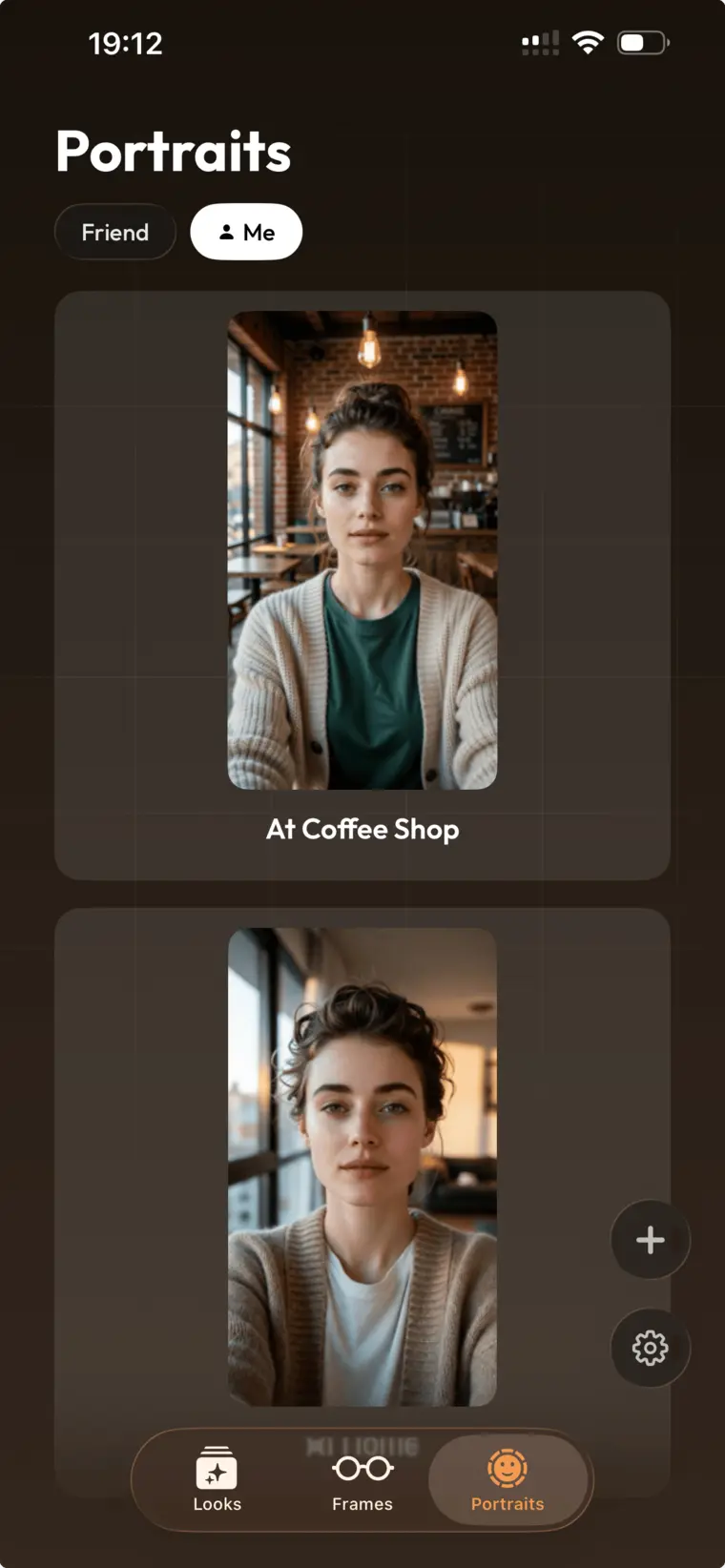
Scan your face

Import any frame

Check the answer
Find your shape in 10 seconds
Scan once. See your face shape, then try real frames on your own face.
Download Frame for iOSWhat do you do once you know your face shape?
Once you know your face shape, pick frames that contrast with it rather than echo it — round faces take angular frames, square faces take rounded ones, and oval faces take almost anything of proportionate width. From there the route depends on what you are buying. For prescription frames, work through how to choose glasses by face shape, or go straight to the shape-specific guide — round faces or square faces. For shades, the dark lens changes the calculus, and best sunglasses for your face shape covers it. Once you have a style, size it with the cheekbone number you just measured, pick a frame color for your skin tone, and get your pupillary distance before you order lenses.